Stocks · Lesson 6 of 15
Orders: Limit Orders, Stop Losses & Halts
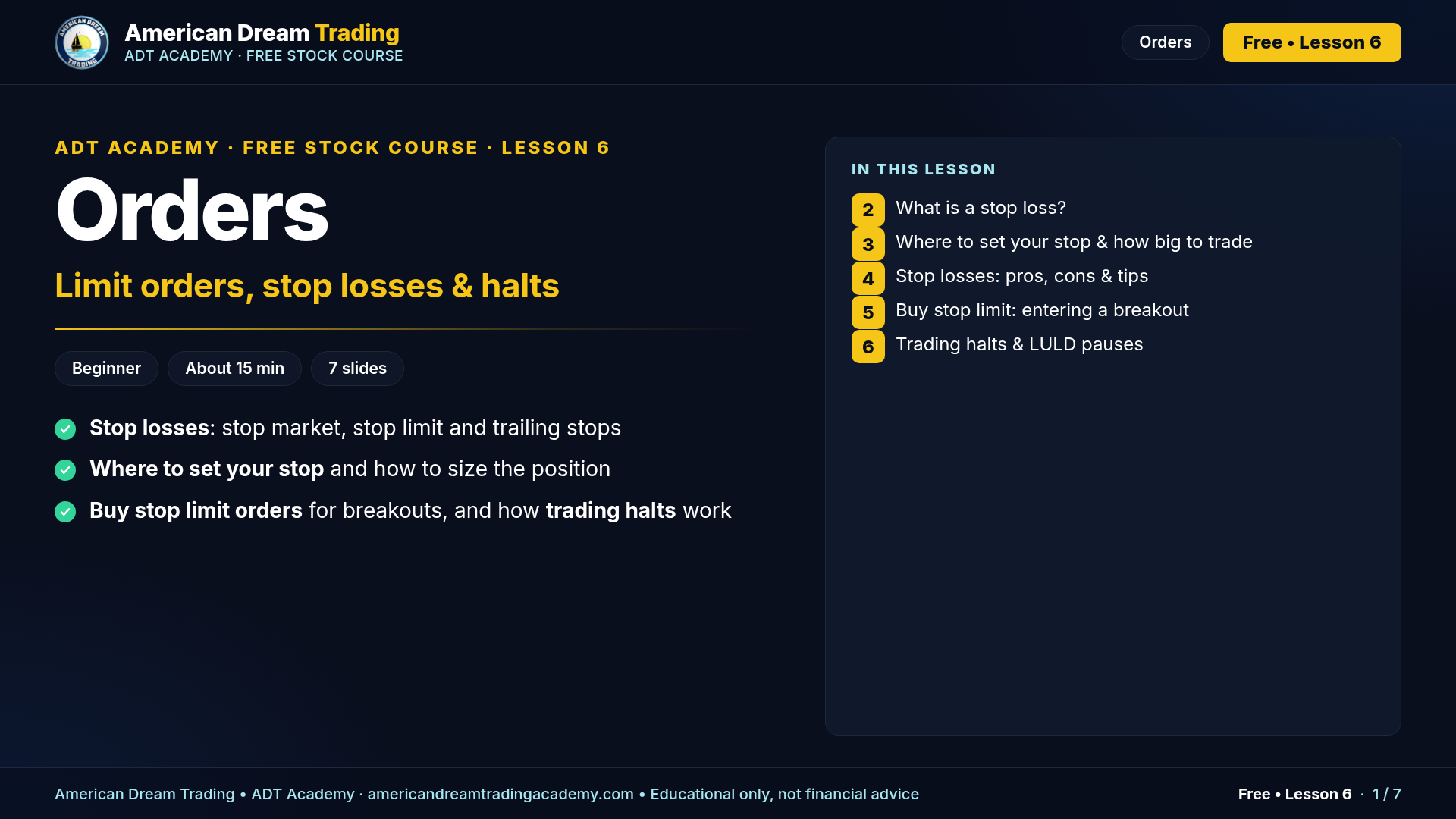
Slide 1 / 7
Level: Beginner · About 15 min · 7 slides
Orders are how you control risk. A stop loss automatically exits a losing trade at a level you choose. A buy stop limit enters a breakout without overpaying. And when a stock moves too fast, the exchange can pause it. Here's how each one works.
🔑 Key takeaways
- Set your stop at entry, every trade (Coach's Rule 5).
- Stop market = fast but can slip. Stop limit = price control but may not fill. Trailing = locks in gains.
- Size from the stop: shares = risk $ ÷ (entry − stop). Risk 1–3% of your account.
- A buy stop limit triggers at the stop and won't pay more than the limit.
- LULD pauses trading for 5 minutes if price sits at its band for 15 seconds.
✅ Your homework
- In paper trading, place a stop market, a stop limit and a trailing stop on one position.
- Size a trade: $10K account, 1% risk, entry $50, stop $49. How many shares?
- Place a buy stop limit above today's high on a watchlist stock.
- Bookmark the Nasdaq Trader trade-halts page and check it during the next big move.
📎 Resources
- Nasdaq Trader trade halts: nasdaqtrader.com/trader.aspx?id=tradehalts
- LULD Plan: luldplan.com
- FINRA: Guardrails for market volatility
- How to enter a stop: Webull (youtube.com/watch?v=WeRt7AtNbvw), Robinhood (learn.robinhood.com), Fidelity, Schwab (schwab.com/content/how-to-place-stop-limit-order), Interactive Brokers (interactivebrokers.com/en/trading/orders/stop.php), E*TRADE
- Investopedia: Buy stop limit
- ADT Academy: https://americandreamtradingacademy.com